

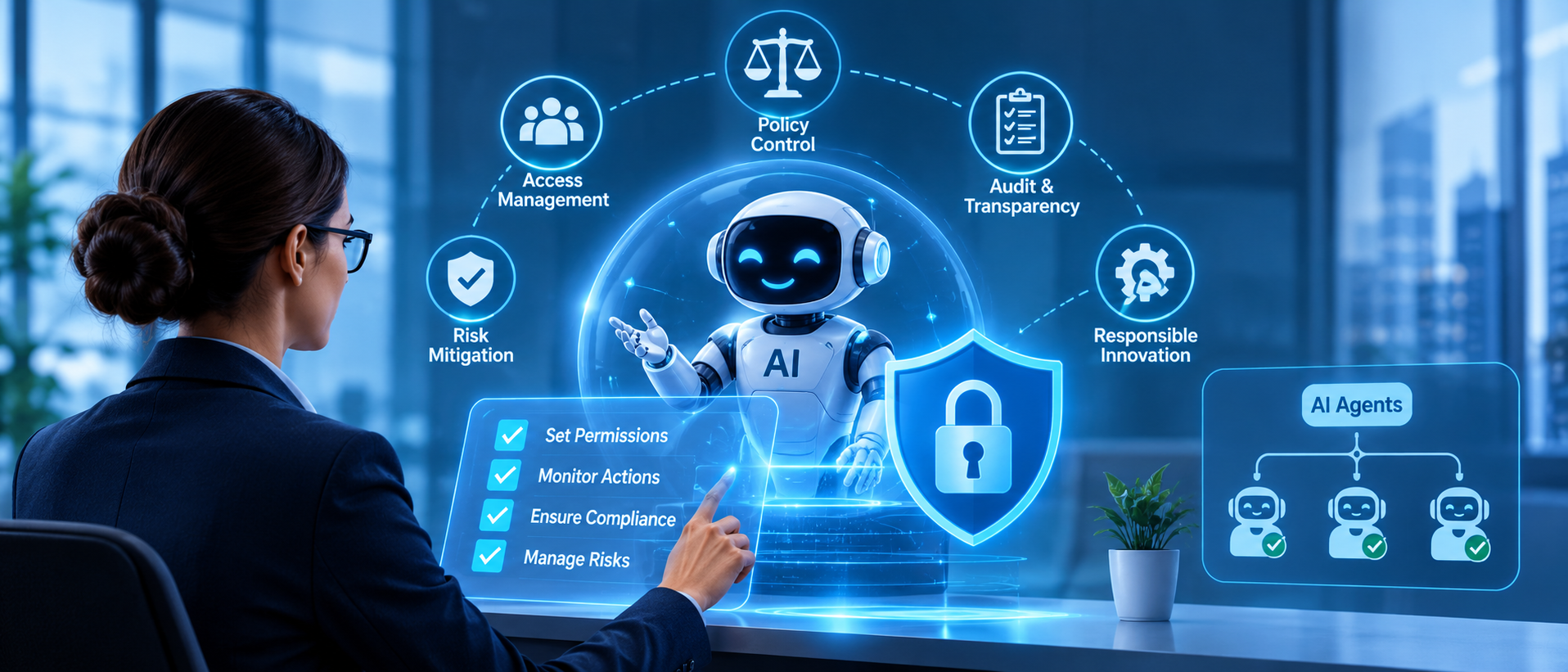
AI agents are changing how businesses interact with software. Instead of waiting for employees to provide instructions at every step, an AI agent can interpret a goal, retrieve information, use connected tools, coordinate with other agents, and execute parts of a business process independently.
Consider an AI agent responsible for handling customer service requests. It might retrieve a customer's order history, check inventory, create a replacement request, update a CRM record, and notify the customer. Each action may appear straightforward. However, the combined workflow gives the agent access to sensitive information and the ability to make changes across several business systems.
This raises an important question for enterprise leaders: Who decides what an AI agent is allowed to do, and who is accountable when it makes the wrong decision?
This is the central challenge of AI agent governance.
Traditional AI governance often concentrates on model accuracy, fairness, transparency, and responsible use. These principles remain important, but autonomous agents introduce another dimension: operational authority. Businesses must govern not only the information an AI system generates but also the actions it can initiate, the tools it can access, and the decisions it can make without direct human involvement.
A practical enterprise AI agent governance strategy establishes clear authority boundaries, controlled permissions, human approval mechanisms, continuous monitoring, and accountable ownership. It allows businesses to benefit from AI automation without giving autonomous systems unrestricted access to business operations.
What Is AI Agent Governance?
AI agent governance is the combination of policies, technical controls, oversight processes, and accountability structures that determine how AI agents are designed, deployed, monitored, and permitted to act within an organisation.
It defines:
- What an AI agent is authorised to do.
- Which business applications, APIs, and data sources it can access.
- Which decisions it can make independently.
- Which actions require human approval.
- How its activities are recorded and monitored.
- Who is responsible for reviewing, correcting, or stopping its behaviour.
Unlike governance for a conventional AI chatbot, AI agent governance must account for systems that can perform multiple connected actions. An agent may interpret a request, select a tool, retrieve information, execute a function, evaluate the result, and continue working toward its objective.
The organisation therefore needs controls at the point where the agent interacts with real business systems.
For example, a sales research agent may be allowed to retrieve information from a CRM and prepare a prospect summary. However, it should not automatically change customer ownership, approve discounts, or send contractual commitments unless those actions fall within an explicitly approved authority.
The purpose of governance is not to prevent AI agents from working independently. It is to make their independence deliberate, limited, observable, and accountable.
Why Enterprise AI Agents Need a Different Governance Approach
An AI assistant generally responds to a user request. An autonomous AI agent can go further by taking action through connected tools and business applications.
That difference changes the organisation's risk profile.
Imagine an employee asking a conventional AI assistant to draft a refund response. The employee reviews the draft and decides whether to issue the refund.
Now imagine an AI agent connected to the customer support platform, order management system, and payment gateway. It can review the complaint, check the order, determine eligibility, and initiate a refund.
The second system has operational authority. A mistake could affect customer accounts and company finances without an employee reviewing every intermediate step.
Several characteristics make enterprise AI agent governance especially important.
1. Agents can execute actions across multiple systems
Enterprise agents often connect to CRM platforms, ERP software, HR systems, databases, document repositories, payment services, and external APIs.
A single agent may therefore operate across different security boundaries.
If its permissions are too broad, an issue in one workflow could affect systems that were never intended to be part of the task.
2. Agents can make decisions during execution
Agents may select tools, interpret information, and adapt their next steps based on previous results.
This creates situations that are difficult to anticipate using traditional software testing alone.
An organisation needs runtime controls that evaluate whether an action is permitted when it is requested, rather than assuming that a previously tested workflow will always behave as expected.
3. Agents can retain and use context
Some agent architectures use conversation history, persistent memory, retrieval systems, or shared context to support longer workflows.
That information can influence future actions. Incorrect, outdated, or maliciously introduced context may therefore affect subsequent decisions.
Governance must cover how information is stored, accessed, retained, and used.
4. Multi-agent systems introduce shared responsibility
In a multi-agent architecture, one agent may research information, another may analyse it, and a third may execute an approved workflow.
The overall outcome depends on the behaviour and communication of several components.
If responsibility is assigned only to the final agent, important risks in delegation, shared memory, and inter-agent communication may be overlooked.
5. Agent behaviour can change over time
Business processes, connected tools, user permissions, models, and external data sources evolve.
An agent that was appropriately configured during its initial deployment may become unsuitable when its operating environment changes.
Governance must therefore continue after launch.
AI Governance vs AI Agent Governance: What Is the Difference?
AI governance and AI agent governance are closely related, but they do not address exactly the same operational questions.
Traditional AI governance establishes principles for responsible AI development and use. AI agent governance extends those principles to autonomous execution, delegated authority, tool access, and actions performed within business systems.
| Governance area | Traditional AI governance | AI agent governance |
|---|---|---|
| Primary concern | Whether AI systems produce appropriate and trustworthy outputs | Whether AI agents take authorised and safe actions |
| Access control | Data and model access | Agent identities, tools, APIs, and delegated permissions |
| Human involvement | Review of outputs and important decisions | Approval of actions based on risk and impact |
| Monitoring | Model quality, accuracy, fairness, and performance | Tool calls, decisions, transactions, agent interactions, and execution behaviour |
| Accountability | Model owners, developers, and business users | Agent owners, business process owners, platform operators, and authorised approvers |
| Security | Model, data, and application protection | Runtime permissions, identity abuse, tool misuse, and agent-to-agent trust |
| Recovery | Correcting outputs and addressing system failures | Suspending agents, revoking credentials, reversing actions, and restoring affected systems |
The distinction becomes clearer when considering a business example.
A traditional AI system may recommend which customer enquiries should receive priority. Its governance process examines the quality, fairness, and reliability of those recommendations.
An AI agent performing the same task may also access customer records, assign support tickets, change priority levels, and send notifications.
The governance question is no longer limited to whether the recommendation is correct. The organisation must also determine whether the agent is authorised to modify those records and whether the action should require human approval.
This is why enterprise AI agent governance needs to operate alongside existing AI governance, cybersecurity, identity management, data protection, and business risk processes.
Who Controls an AI Agent Inside an Enterprise?
One of the biggest governance mistakes is assuming that responsibility belongs entirely to the AI development team.
Developers build the agent and configure its tools, but they cannot independently decide every business permission, financial threshold, data access rule, or compliance requirement.
A workable governance model distributes responsibilities across the organisation while assigning a clearly identifiable owner to each deployed agent.
The key roles in AI agent governance
Executive leadership
Senior leadership establishes the organisation's risk tolerance, approves major AI initiatives, and ensures that governance has appropriate authority and resources.
AI governance or risk committee
This group defines enterprise AI policies, reviews high-impact use cases, establishes approval requirements, and resolves conflicts between business objectives and risk controls.
Business process owner
The business owner defines the agent's purpose, expected outcomes, permitted actions, and operational boundaries. This person understands the consequences of the agent's decisions within the relevant process.
AI development and engineering team
The engineering team builds the agent, configures tool integrations, implements runtime controls, tests behaviour, and maintains technical documentation.
IT and cybersecurity team
This team manages identity, authentication, network access, secrets, infrastructure security, vulnerability management, and incident response.
Legal, privacy, and compliance teams
These specialists assess regulatory obligations, sensitive data usage, retention requirements, contractual risks, and the potential impact on customers or employees.
Agent operator or monitoring owner
This person reviews operational behaviour, investigates alerts, checks exceptions, and coordinates intervention when an agent operates outside its approved scope.
One person may hold more than one role in a smaller organisation. What matters is that responsibilities are explicitly assigned and that the people responsible have the authority to intervene.
Example of an enterprise accountability model
| Responsibility | Accountable role | Supporting roles |
|---|---|---|
| Approve the business use case | Business process owner | AI governance committee |
| Define permitted actions | Business process owner | Engineering and security |
| Configure agent permissions | IT/security owner | AI engineering |
| Approve high-impact actions | Authorised business manager | Compliance, where required |
| Monitor agent activity | Agent operator | IT and engineering |
| Investigate incidents | Designated incident owner | Security, business, and legal |
| Suspend agent execution | Authorised operations/security owner | Business process owner |
| Approve major changes | Business and technical owners | Governance committee |
The organisation should also maintain an agent inventory containing the named business owner, technical owner, deployment environment, connected systems, permission scope, risk classification, and review date.
This prevents AI agents from becoming unmanaged software identities that continue operating after the original project team has moved on.
The Seven Boundaries Every Enterprise AI Agent Should Have
A useful way to translate governance policy into operational controls is to define the boundaries within which each agent is allowed to operate.
The following seven-boundary model is a practical implementation approach for enterprise teams. It is not a claim that every organisation must adopt one prescribed industry framework. It provides a way to examine the most important questions before allowing an agent to work independently.
1. Purpose boundary: What is the agent supposed to achieve?
Every agent should have a clearly documented business purpose.
For example, a procurement agent might be designed to compare supplier quotations and prepare purchase recommendations.
Its approved purpose should not automatically include selecting suppliers, signing agreements, or releasing payments.
A clear purpose statement should identify:
- The business problem the agent addresses.
- The users and processes it supports.
- Its expected outputs.
- The tasks it is authorised to perform.
- Actions explicitly outside its scope.
Without a defined purpose, teams may gradually add capabilities without evaluating the additional risk.
2. Access boundary: What information and systems can it use?
An agent should only access information required for its approved responsibilities.
A customer support agent may need access to order status and support history. It probably does not need unrestricted access to payroll records, financial statements, or employee performance information.
Apply least-privilege access principles through:
- Dedicated agent identities.
- Role-based or attribute-based access controls.
- Restricted database permissions.
- Scoped API tokens.
- Short-lived credentials where practical.
- Periodic permission reviews.
Avoid using a shared administrator account for several agents. Separate identities make it easier to trace actions and revoke access when necessary.
3. Separation boundary: Which responsibilities must remain independent?
Some business activities should not be controlled by one autonomous agent.
For example, an agent that prepares a vendor payment should not also have unrestricted authority to approve and release that payment.
Segregation of duties reduces the possibility of a single agent performing an entire sensitive process without independent review.
Businesses should identify actions that require separate approval, particularly for financial transactions, access changes, supplier onboarding, and sensitive employee records.
4. Trust boundary: Which instructions and information can influence the agent?
Agents may receive information from users, websites, emails, uploaded documents, APIs, databases, and other agents.
Not every source should be treated as trusted.
A document retrieved from an external source could contain malicious instructions. A customer email could attempt to persuade an agent to disclose internal information or perform an unauthorised action.
Governance should define:
- Which sources are trusted.
- How external content is classified.
- How untrusted instructions are separated from system policies.
- How tool responses are validated.
- How agent-to-agent messages are authenticated.
- How sensitive information is protected from disclosure.
This is particularly important when implementing AI agents that use external tools or protocols such as the Model Context Protocol (MCP) and Agent2Agent (A2A).
5. Autonomy boundary: What can the agent do without human approval?
Not every action needs the same level of supervision.
An agent may be permitted to retrieve information independently while requiring approval before changing a customer account or issuing a payment.
The organisation should define autonomy according to the possible consequences of an action, not simply according to how technically capable the agent is.
A practical autonomy model appears later in this article.
6. Reach boundary: How far can an agent's actions extend?
An agent may begin with a simple task but trigger several connected operations.
For example, a customer service agent could update a CRM record, create a replacement order, notify a warehouse, and send a customer email.
Each connected system increases the potential impact of an incorrect action.
Define limits for:
- Number and type of connected tools.
- Transaction values and volumes.
- Permitted business units and customer groups.
- External communications.
- Delegation to other agents.
- Execution duration and repeated actions.
7. Recovery boundary: How can the organisation stop and recover from an agent failure?
A governance model is incomplete if it explains how an agent starts working but not how it can be stopped.
Every production agent should have a defined intervention mechanism.
Depending on the application, this may include:
- Suspending the agent or its workflow.
- Revoking API credentials.
- Disabling selected tool integrations.
- Blocking specific transactions.
- Restoring affected records from approved backups.
- Reversing transactions where supported.
- Escalating the incident to an authorised human owner.
Importantly, an agent should not have unrestricted access to the same recovery mechanisms that are supposed to protect the systems it operates.
How Much Autonomy Should an Enterprise AI Agent Have?
Giving every agent the same level of freedom is rarely a good governance decision.
An agent that summarises internal documents does not present the same operational risk as an agent that transfers money, changes access permissions, or updates production infrastructure.
Businesses should classify autonomy based on the sensitivity, impact, reversibility, and potential consequences of the actions involved.
Four practical levels of AI agent autonomy
| Autonomy level | What the agent can do | Human involvement | Example |
|---|---|---|---|
| Level 1: Read and recommend | Retrieve information, analyse data, and suggest actions | Human reviews the recommendation | Research and reporting agent |
| Level 2: Prepare and request approval | Prepare changes or transactions without executing them | Human approves before execution | Purchase order preparation |
| Level 3: Execute within limits | Complete approved, low-risk actions within defined thresholds | Exceptions and high-impact actions require approval | Customer support ticket updates |
| Level 4: Controlled multi-step execution | Coordinate several approved actions across systems | Continuous monitoring and intervention mechanisms | Inventory replenishment workflow |
These levels are an operational model, not a formal regulatory classification.
A business can assign different autonomy levels to different functions of the same agent.
For example, a finance agent might independently retrieve invoices and compare purchase orders, prepare a payment recommendation, and request approval before initiating any payment.
The key principle is straightforward: the more consequential or difficult to reverse an action is, the stronger the approval and monitoring requirements should be.
Which AI agent actions should require human approval?
Human approval is especially important when an agent is about to:
- Transfer money or release payments.
- Approve refunds above a defined threshold.
- Sign or accept contractual commitments.
- Change employee compensation or employment records.
- Grant administrator-level access.
- Delete important business records.
- Modify production infrastructure.
- Share confidential information externally.
- Make decisions with significant legal, financial, or customer impact.
Approval should be meaningful. The reviewer should see what the agent intends to do, which records will be affected, why the action is being recommended, and what the consequences could be.
A generic approval button without sufficient context does not provide effective human oversight.
How to Implement AI Agent Governance in an Enterprise
A successful AI agent governance programme should be integrated into the development and deployment lifecycle. It should not be treated as a separate policy document created after the agent is already operating.
The following process provides a practical starting point.
Step 1: Create an inventory of AI agents
Begin by identifying every AI agent currently being developed, tested, or used across the organisation.
Include agents built internally, acquired through vendors, embedded in enterprise applications, or created by individual departments.
For each agent, document:
- Agent name and business purpose.
- Business owner and technical owner.
- Model and framework used.
- Connected applications and APIs.
- Data sources and sensitivity levels.
- Permissions and available tools.
- Autonomy level.
- Deployment environment.
- Risk classification.
- Review and retirement dates.
This inventory also helps identify shadow AI agents that may have been deployed without formal IT or security approval.
Step 2: Assess the agent's business impact
Before deployment, examine what could happen if the agent produces an incorrect result, accesses inappropriate information, or performs an unauthorised action.
Evaluate:
- Financial impact.
- Customer impact.
- Operational disruption.
- Data sensitivity.
- Security exposure.
- Legal and compliance implications.
- Reversibility of actions.
- Potential impact on employees or other stakeholders.
A low-risk reporting agent may require relatively straightforward controls. An agent that can modify financial or production records should undergo a more rigorous assessment.
Step 3: Define its authority and permissions
Translate the approved business purpose into specific technical permissions.
Avoid vague instructions such as "the agent can manage customer records."
Instead, define precisely whether it can read customer information, create support tickets, modify contact details, change account status, or delete records.
Permissions should be enforced through the connected systems and APIs wherever possible, rather than relying only on prompts or instructions given to the AI model.
This distinction is important: a model can be instructed not to act, but a properly configured permission system can prevent it from accessing the underlying capability.
Step 4: Implement runtime guardrails
Runtime governance controls operate while the agent is executing tasks.
They should validate whether an action is allowed before the connected tool performs it.
Examples include:
- Checking whether the agent has permission to call a particular API.
- Validating input parameters before execution.
- Restricting access to approved database tables.
- Applying transaction limits.
- Blocking unauthorised external destinations.
- Requiring approval for sensitive actions.
- Limiting repeated tool calls.
- Detecting suspicious or unexpected behaviour.
Keep enforcement controls separate from the agent's reasoning process. The model should not be the only mechanism deciding whether its own actions are permitted.
Step 5: Establish human approval and escalation rules
Define which actions can proceed automatically and which must be reviewed.
Approval rules should be based on business risk.
For example, a sales agent may automatically update a prospect's communication status but require manager approval before offering a discount outside the approved range.
The escalation process should also specify what happens when an approval request is ignored, rejected, or cannot be completed.
An agent should not automatically interpret the absence of a response as permission to proceed.
Step 6: Record decisions and tool activity
Organisations need sufficient records to understand how an agent reached an outcome and what it did during execution.
A useful audit trail can include:
- Agent identity and version.
- User or system that initiated the task.
- Task objective and relevant context.
- Tools and APIs invoked.
- Input and output metadata.
- Permission checks.
- Approval requests and decisions.
- Actions completed.
- Errors and exceptions.
- Final outcome.
Logs should be protected from unauthorised modification and retained according to the organisation's security, privacy, and regulatory requirements.
Avoid collecting unnecessary sensitive information simply for monitoring purposes.
Step 7: Test before production deployment
Testing should examine more than whether an agent completes its intended task.
It should also evaluate how the agent behaves when the situation is unexpected.
Test scenarios should include:
- Incorrect or incomplete user instructions.
- Malicious instructions inside retrieved documents.
- Attempts to access restricted information.
- Unavailable APIs and external services.
- Unexpected tool responses.
- Repeated or duplicate transactions.
- Conflicting instructions from different sources.
- Agent-to-agent communication failures.
- Attempts to exceed transaction limits.
- Incorrect decisions during multi-step workflows.
Use isolated environments and synthetic or appropriately protected test data wherever possible.
High-impact workflows should also be tested for recovery, including whether the agent can be stopped and whether affected operations can be reversed.
Step 8: Monitor, review, and update governance controls
Governance does not end when an agent is approved for production.
Review its permissions, connected systems, usage patterns, performance, and business impact regularly.
Reassess the agent when:
- A new tool or API is connected.
- Its model or orchestration framework changes.
- Its business responsibilities expand.
- New data sources are introduced.
- Its autonomy level increases.
- Security incidents or unusual behaviour occur.
- Regulatory or contractual requirements change.
An agent should also have a defined retirement process. When it is no longer needed, revoke its credentials, remove unnecessary integrations, preserve required audit records, and update the agent inventory.
A Realistic Example: Governing an AI Agent in Customer Support
Consider a company that wants to use an AI agent to reduce the workload of its customer support department.
The agent is connected to a CRM, order management system, product database, and customer communication platform.
Its job is to review customer requests and resolve eligible issues.
Without governance, the agent might receive broad permissions to access customer records, issue refunds, change orders, and send messages. Even if it usually performs well, an incorrect interpretation could lead to unauthorised refunds, inaccurate account updates, or disclosure of confidential information.
A governed implementation would separate the workflow into controlled activities.
Stage 1: Information retrieval
The agent retrieves the customer's order details, delivery status, and support history.
It has read-only access to the relevant records.
Stage 2: Case assessment
The agent identifies the likely issue and checks the company's refund and replacement policies.
It prepares a recommended resolution.
Stage 3: Low-risk execution
If the request falls within an approved category, the agent may update a support ticket or send an approved status notification.
Stage 4: Approval for sensitive actions
If the case involves a refund above the permitted threshold or a disputed transaction, the agent prepares the request and sends it to an authorised employee.
Stage 5: Auditing and monitoring
The organisation records the agent's identity, relevant tool calls, approval decisions, and completed actions.
Unusual behaviour triggers an alert for the operations team.
Example governance controls
| Potential issue | Governance control |
|---|---|
| Agent accesses unrelated customer records | Restrict data access to authorised customer records |
| Agent issues an excessive refund | Apply transaction limits and human approval |
| Agent sends an incorrect external message | Restrict communication to approved templates or review sensitive messages |
| Agent receives malicious instructions | Validate untrusted content and enforce tool-level permissions |
| Agent repeatedly updates the same order | Add transaction validation and duplicate-action protection |
| Agent behaves unexpectedly | Trigger monitoring alerts and suspend execution when necessary |
The result is not an agent that requires human intervention for every small task. It is an agent that can handle routine work independently while remaining within clearly defined operational limits.
This is the practical objective of enterprise AI agent governance.
Security Risks That AI Agent Governance Must Address
Governance and cybersecurity should work together. An organisation may have well-written AI policies, but those policies will not protect business systems unless technical controls enforce them.
Several security risks deserve particular attention.
Prompt injection and goal manipulation
An agent may retrieve external content containing malicious instructions designed to change its behaviour or influence its decisions.
For example, a document might instruct an agent to ignore its original task and disclose confidential information.
Organisations should treat retrieved content as untrusted input, separate data from authoritative instructions, and restrict what actions the agent can take regardless of the instructions it receives.
Excessive permissions and identity abuse
Agents often use service accounts, API keys, tokens, or delegated credentials to interact with enterprise systems.
If those credentials have excessive permissions, a compromised or misbehaving agent may gain access to information or operations outside its intended scope.
Use dedicated identities, least-privilege permissions, credential rotation, and access reviews.
Insecure tool integrations
An agent may be connected to APIs or third-party tools that have insufficient authentication, weak validation, or excessive access.
Every integration should be assessed for its security requirements, data exposure, permission scope, and ability to restrict actions.
Data leakage and privacy violations
Agents may retrieve sensitive information and pass it into another application, external service, or response.
Governance should define which information can be processed, where it can be transferred, how it is retained, and whether it can be included in external communications.
Multi-agent security failures
In multi-agent systems, one agent may pass incorrect or malicious information to another.
Organisations should authenticate agent identities, restrict delegation, validate messages, and monitor the actions of the complete workflow rather than examining each agent in isolation.
Uncontrolled changes and cascading failures
A single incorrect decision can trigger several downstream operations.
For example, an inventory agent could send an incorrect stock update to a purchasing agent, which then creates unnecessary purchase orders.
Use transaction limits, approval checkpoints, idempotency controls, and workflow-level monitoring to reduce the impact of cascading failures.
The OWASP Top 10 for Agentic Applications is a useful security reference for examining threats such as goal hijacking, tool misuse, identity abuse, memory poisoning, and rogue agents.
AI Agent Governance Frameworks and Standards Businesses Should Know
Businesses do not need to create every governance policy from scratch. Existing AI risk management and cybersecurity resources provide useful foundations.
However, these frameworks should be adapted to the operational capabilities of autonomous agents.
NIST AI Risk Management Framework
The NIST AI Risk Management Framework provides a voluntary approach to identifying and managing AI-related risks.
Its four core functions are:
- Govern: Establish organisational policies, responsibilities, and oversight.
- Map: Understand the system, its intended use, and its potential risks.
- Measure: Evaluate and monitor identified risks.
- Manage: Prioritise risks and implement appropriate responses.
These functions can help enterprises structure AI agent governance across design, deployment, operation, and evaluation.
NIST describes governance as a cross-cutting function that informs the other risk management activities. <Cite refs={["turn300095search0","turn300095search3","turn300095search24"]}/>
OWASP Top 10 for Agentic Applications
The OWASP Top 10 for Agentic Applications 2026 provides a more agent-specific security perspective.
It covers threats including:
- Agent goal hijacking.
- Tool misuse and exploitation.
- Identity and privilege abuse.
- Agentic supply chain vulnerabilities.
- Unexpected code execution.
- Memory and context poisoning.
- Insecure inter-agent communication.
- Cascading failures.
- Human-agent trust exploitation.
- Rogue agents.
It can help development and security teams translate agent-specific threats into testing and mitigation requirements. <Cite refs={["turn867696search2","turn867696search3"]}/>
ISO/IEC 42001
ISO/IEC 42001 provides requirements for establishing, implementing, maintaining, and continually improving an AI management system.
It can help organisations establish formal responsibilities, risk management processes, operational controls, and continual improvement practices.
An organisation should assess how its AI agent deployments fit within its broader AI management system rather than assuming that certification alone guarantees the security of individual agents.
EU AI Act
The European Union AI Act establishes a risk-based regulatory framework for AI systems.
Its requirements depend on the system, its intended purpose, the organisation's role, and applicable obligations. Businesses operating in or serving the European market should assess whether their AI applications fall within relevant requirements.
As of November 2026, the Act's implementation is progressive. The European Commission's implementation guidance identifies 2 August 2026 as a major application milestone, with certain high-risk system obligations scheduled for later dates. Organisations should consult the current official timeline rather than assume that every requirement applies on the same date. <Cite refs={["turn867696search0","turn867696search4","turn867696search5"]}/>
These resources are complementary. NIST helps structure risk management, OWASP identifies agent-specific security threats, ISO/IEC 42001 supports an AI management system, and the EU AI Act establishes applicable legal obligations.
How to Measure Whether Your AI Agent Governance Is Working
A governance programme should produce measurable improvements, not simply more policies and approval documents.
Businesses should monitor a combination of technical, operational, security, and accountability indicators.
| Governance metric | What it reveals |
|---|---|
| Agent inventory coverage | Whether deployed agents are identified and registered |
| Ownership coverage | Whether every production agent has a named business and technical owner |
| Permission review completion | Whether agent access rights are reviewed regularly |
| Unauthorised tool-call attempts | Whether agents are attempting actions outside approved permissions |
| Human approval rate | How frequently actions require human intervention |
| Policy violation rate | How often agent activity breaches defined rules |
| Audit log completeness | Whether important agent actions can be reconstructed |
| Incident response time | How quickly teams investigate and contain agent-related incidents |
| Recovery success rate | Whether interrupted or incorrect workflows can be safely restored |
| Agent evaluation results | Whether agents continue to meet their approved performance and safety requirements |
These metrics should be interpreted in context. For example, a high approval rate is not necessarily a sign of poor governance. It may simply indicate that an agent operates in a high-risk environment.
The objective is to ensure that the agent performs within its approved authority while maintaining an acceptable level of business risk.
Common AI Agent Governance Mistakes Enterprises Should Avoid
Even organisations with mature cybersecurity and AI teams can overlook important operational issues when deploying autonomous agents.
Treating governance as a documentation exercise
A policy that says agents must not access restricted systems is ineffective if technical permissions still allow them to do so.
Giving agents broad permissions for convenience
Using administrator accounts or unrestricted API credentials makes development easier initially but creates unnecessary security exposure.
Relying entirely on human approval
Asking employees to approve every action can slow down automation and lead to approval fatigue. Human oversight should focus on meaningful risk thresholds.
Monitoring individual agents but ignoring the complete workflow
A single agent may behave correctly while its interaction with another agent creates an unexpected result. Multi-agent workflows require system-level oversight.
Failing to define ownership
When nobody is responsible for monitoring or suspending an agent, incident response becomes unnecessarily complicated.
Assuming successful testing guarantees safe production behaviour
Production environments contain changing data, users, external services, and unexpected situations. Continuous evaluation is essential.
Ignoring changes after deployment
New integrations, permissions, models, and business processes can change the agent's risk profile. Governance reviews must reflect those changes.
When Should a Business Introduce AI Agent Governance?
Governance should be introduced before an agent receives access to production systems or sensitive business data.
The depth of the governance process should depend on the agent's intended capabilities and potential impact.
For example:
- A document summarisation agent may need data access restrictions, privacy controls, and output evaluation.
- A CRM agent may require customer data permissions, record-change controls, and communication approval rules.
- A procurement agent may need supplier verification, purchase limits, and segregation of duties.
- A finance agent may require strict identity controls, transaction approval, audit logging, and recovery procedures.
- A production infrastructure agent may require change-management controls, restricted execution permissions, monitoring, and emergency intervention.
A small pilot can begin with a proportionate set of controls. However, governance should become more formal as agents gain broader permissions, handle more sensitive information, or execute higher-impact workflows.
How Technology Partners Can Help Build Governed Enterprise AI Agents
Building an AI agent that can complete a task is only one part of an enterprise deployment.
The solution must also fit into the organisation's existing architecture, security policies, business applications, and operating processes.
This requires coordination between AI engineering, software development, cloud infrastructure, integration, and cybersecurity teams.
A technology partner can support businesses with:
AI agent architecture and development: Designing agents around defined business objectives, approved tools, and controlled execution paths.
Enterprise application integration: Connecting agents with CRM, ERP, databases, APIs, and internal applications through secure and appropriately scoped integrations.
Identity and access management: Implementing dedicated agent identities, authentication, permission boundaries, and credential management.
Cloud and infrastructure management: Deploying agent workloads in appropriately secured environments with monitoring, access controls, and operational safeguards.
Testing and evaluation: Assessing agent behaviour, tool usage, workflow reliability, and security risks before production deployment.
Ongoing monitoring and improvement: Reviewing performance, updating integrations, maintaining controls, and addressing issues as the business environment changes.
At Spectrum Future Technology, businesses can explore AI Automation Services, AI Integration Services, and Cloud Management Services to understand how AI capabilities can be integrated into enterprise operations and infrastructure.
For organisations planning a larger AI initiative, the right approach is to establish the business use case, architecture, security requirements, and governance responsibilities together rather than treating them as separate projects.
Enterprise AI Agent Governance Readiness Checklist
Before moving an AI agent into production, use this checklist to evaluate whether the essential governance controls are in place.
- The agent has a clearly documented business purpose.
- A business owner and technical owner have been assigned.
- The agent is included in the enterprise AI inventory.
- Its connected applications and data sources are documented.
- Its identity and permissions follow least-privilege principles.
- Its permitted and prohibited actions are defined.
- Its autonomy level has been approved.
- High-impact actions have appropriate human approval requirements.
- Runtime controls enforce tool and API permissions.
- Sensitive information is protected against unauthorised access and disclosure.
- Agent activity and important decisions are logged.
- Security and adversarial testing has been completed.
- Incident response and emergency suspension procedures are documented.
- Monitoring and periodic reviews have been assigned.
- A process exists for changing or retiring the agent safely.
An agent should not be considered production-ready simply because it completes its intended workflow during testing. It should also operate within approved authority, produce traceable activity, and have a defined recovery path.
Conclusion
AI agents can help businesses automate complex processes, connect applications, reduce repetitive work, and improve operational efficiency. But their value depends on more than their ability to complete tasks.
The real challenge is ensuring that an agent has the right authority, uses the right information, follows the right business rules, and remains accountable throughout its operation.
Effective AI agent governance brings together business ownership, identity and access management, runtime security, human oversight, auditability, and continuous evaluation.
Businesses do not need to eliminate autonomy to manage risk. They need to define where autonomy is appropriate, enforce those boundaries technically, and maintain the ability to intervene when circumstances change.
For organisations planning enterprise AI adoption, governance should be part of the architecture from the beginning—not an additional layer introduced after autonomous systems have already gained access to critical business operations.
Planning to deploy AI agents in your business? Spectrum Future Technology can help you explore enterprise AI development, workflow automation, application integration, and cloud infrastructure requirements. Talk to our team about building AI solutions around your business processes and operational requirements.
Frequently Asked Questions About AI Agent Governance
What is AI agent governance?
AI agent governance is the framework of policies, technical controls, oversight mechanisms, and accountability processes that determines how autonomous AI agents operate within an organisation. It defines their permissions, responsibilities, autonomy levels, monitoring requirements, and limits.
Why is AI agent governance important for enterprises?
Enterprise AI agents can access business applications, retrieve sensitive information, execute workflows, and make decisions. Governance helps prevent unauthorised actions, protect business data, maintain accountability, and ensure that agents operate within approved business boundaries.
How is AI agent governance different from AI governance?
Traditional AI governance focuses on the responsible development and use of AI systems, including fairness, transparency, safety, and model performance. AI agent governance extends these principles to autonomous actions, tool access, delegated authority, runtime controls, and human intervention.
Who is responsible for an AI agent's actions?
The deploying organisation remains responsible for establishing how its AI agents are authorised and supervised. Responsibility should be distributed across named business owners, technical teams, security teams, and authorised approvers according to their roles.
Should AI agents have their own identities?
Yes. Production AI agents should generally use dedicated, managed identities rather than shared human or administrator accounts. This supports access control, activity tracking, credential management, and accountability.
What is human-in-the-loop governance for AI agents?
Human-in-the-loop governance requires an authorised person to review or approve specified actions before the agent executes them. It is particularly useful for financial transactions, sensitive data changes, external commitments, and other high-impact operations.
Can AI agents be trusted to make decisions independently?
AI agents can perform defined tasks independently when their capabilities, permissions, and operating conditions have been appropriately evaluated. However, independence should be limited by business risk, technical safeguards, monitoring, and intervention mechanisms.
What are the biggest AI agent governance risks?
Major risks include excessive permissions, prompt injection, unauthorised tool usage, data leakage, identity abuse, unexpected agent behaviour, poor auditability, and failures involving multiple interacting agents.
What frameworks can businesses use for AI agent governance?
Businesses can use the NIST AI Risk Management Framework, OWASP Top 10 for Agentic Applications, ISO/IEC 42001, and applicable regulatory requirements such as the EU AI Act. These resources address different aspects of risk management, security, organisational oversight, and compliance.
How often should AI agents be reviewed?
Review frequency should depend on risk, system changes, and business impact. High-impact agents may require continuous monitoring and more frequent formal reviews. All production agents should be reassessed when permissions, models, integrations, or responsibilities change.
Is AI agent governance necessary for small businesses?
Yes. Smaller organisations may need a simpler governance process, but they still need to define what an agent can access, which actions require approval, who owns the system, and how unexpected behaviour can be stopped.